• Graduate Programs
    • Tinbergen Institute Research Master in Economics
      • Why Tinbergen Institute?
      • Research Master
      • Admissions
      • All Placement Records
      • PhD Vacancies
    • Facilities
    • Research Master Business Data Science
    • Education for external participants
    • Summer School
    • Tinbergen Institute Lectures
    • PhD Vacancies
  • Research
  • Browse our Courses
  • Events
    • Summer School
      • Applied Public Policy Evaluation
      • Deep Learning
      • Development Economics
      • Economics of Blockchain and Digital Currencies
      • Economics of Climate Change
      • The Economics of Crime
      • Foundations of Machine Learning with Applications in Python
      • From Preference to Choice: The Economic Theory of Decision-Making
      • Inequalities in Health and Healthcare
      • Marketing Research with Purpose
      • Markets with Frictions
      • Modern Toolbox for Spatial and Functional Data
      • Sustainable Finance
      • Tuition Fees and Payment
      • Business Data Science Summer School Program
    • Events Calendar
    • Events Archive
    • Tinbergen Institute Lectures
    • 2026 Tinbergen Institute Opening Conference
    • Annual Tinbergen Institute Conference
  • News
  • Summer School
  • Alumni
    • PhD Theses
    • Master Theses
    • Selected PhD Placements
    • Key alumni publications
    • Alumni Community

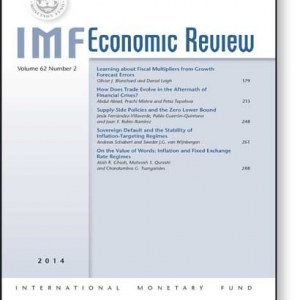
Schabert, A. and \van Wijnbergen\, S.J.G. (2014). Sovereign default and the stability of inflation targeting regimes IMF Economic Review, 62(2):261--287.


  • Affiliated author
    Sweder van Wijnbergen
  • Publication year
    2014
  • Journal
    IMF Economic Review

We analyze the impact of interactions between monetary and fiscal policy on macroeconomic stability. We find that in the presence of sovereign default, macroeconomic stability requires monetary policy to be passive if the feedback from debt surprises back to the primary surplus is too weak. An active monetary policy can however only contribute to the stabilization inflation and output, if the primary surplus is increasing in debt with a slope that increases with the default probability. The results are relevant for the design of fiscal and monetary policy in emerging markets where sovereign credibility is not well established. Recent debt developments in Western Europe and in the United States suggest these results may become relevant for more mature financial markets too once the current low inflation period is over.