AI Agents in Economics and Business Research
This two-day workshop provides researchers and practitioners with both the conceptual foundations and practical tools needed to apply AI in economics and business research, while emphasizing responsible use.
Dates: May 13-14, 2027
Faculty
Finn-Ole Höner is a PhD candidate for AI in Marketing at the Erasmus School of Economics. His work focuses on the conceptualization of how AI agents can be used to foster innovation in retail settings, the investigation of LLMs as tools for market research, and the development of new AI models that advance marketing science. 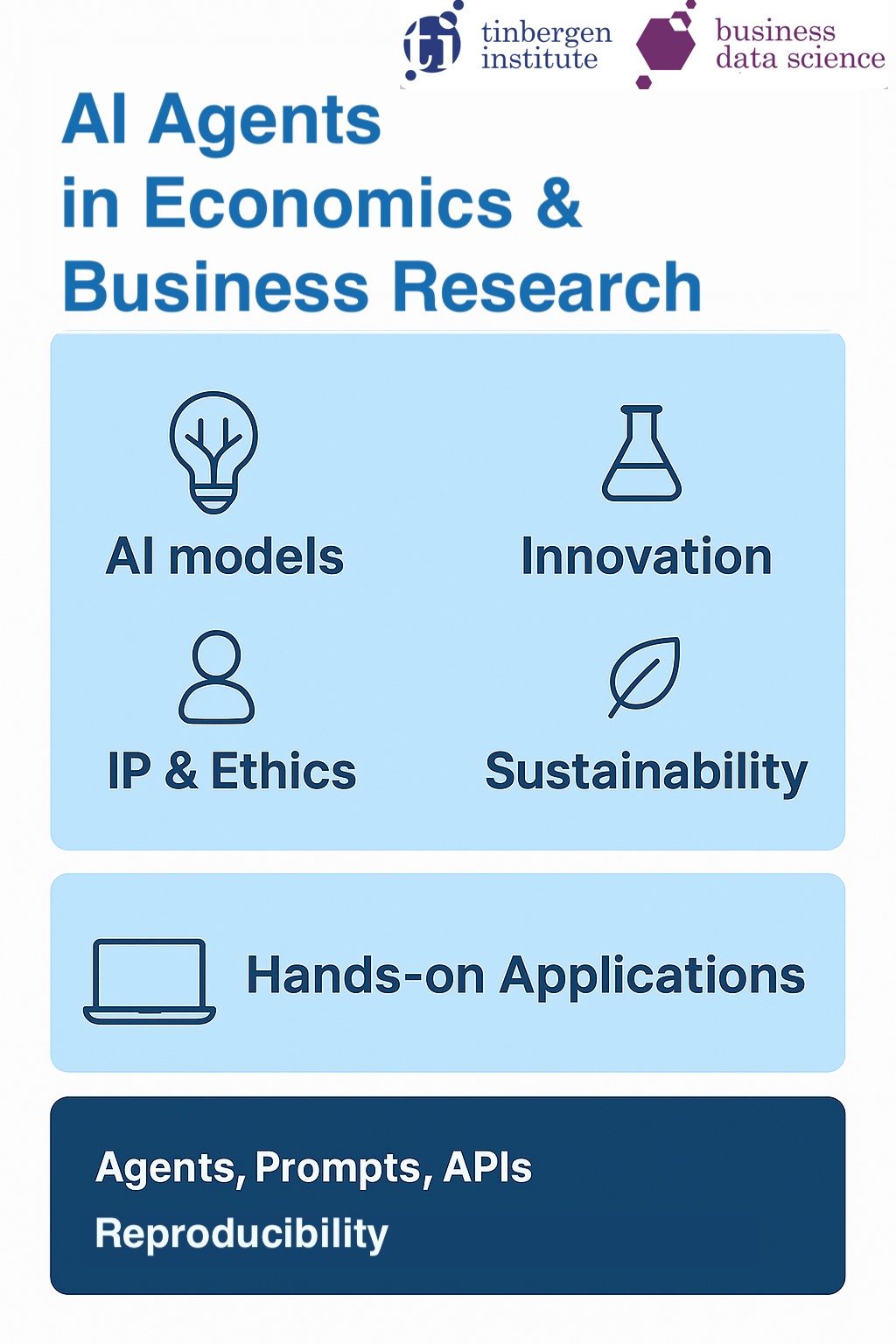
With a background spanning computer science, data science, and econometrics, he bridges technical and marketing disciplines in both his teaching and research. He has taught in courses on text analytics, natural language processing, and machine learning, combining hands-on programming expertise with a deep understanding of data-driven decision-making and AI.
Course
This workshop equips both researchers and practitioners with the conceptual foundations and hands-on tools needed to apply AI models in economics and business research, as well as the responsible use of AI models. The content emphasizes how AI can support market research, innovation (e.g. ideation), and everyday tasks such as programming. Beyond the foundations, key themes will include context engineering, the use of AI agents, and an overview of image, video, world models. In this intense workshop, participants will be diving into the state of the art and practice using AI in hands-on practice.
Learning Objectives
Participants will learn to
- use LLM–based AI agents to tackle complex research and managerial problems in areas such as market research, ideation, and data analysis;
- apply core techniques in context engineering and multi-agent design, while paying attention to responsible use, and sustainability considerations;
- understand the basics of inner workings of language, image, video, and world-model AI systems;
- build hands-on workflows that integrate LLMs into everyday analytical and programming tasks, with attention to reliability, bias, environmental impact, and practical debugging.
Topics
- Large Language Models
- AI Agents
- Responsible AI
- AI for innovation, (market) research
- AI supported programming
Level
The Summer School welcomes PhD students, post-docs, TI & BDS Fellows, as well as practitioners who are interested in AI models.
| Item | Information |
| Academic Lead | Finn-Ole Höner |
| Degree program | Certificate |
| Credits | Participants who joined at least 80% of all sessions and pass all (group) assignments successfully, receive a certificate of participation stating that the course is equivalent to a workload of 1 ECTS. Note that it is the student’s own responsibility to get these credits registered at their own university. |
| Mode | Short-term |
| Language | English |
| Venue | Tinbergen Institute Amsterdam, Roetersstraat 11, 1018 WB, Amsterdam |
| Capacity | 30-45 |
| Fees | Tuition Fees and Payment |
| Application deadline | tba |
| Apply here | Registration for the 2027 is not yet open. |