• Graduate Programs
    • Tinbergen Institute Research Master in Economics
      • Why Tinbergen Institute?
      • Research Master
      • Admissions
      • All Placement Records
      • PhD Vacancies
    • Facilities
    • Research Master Business Data Science
    • Education for external participants
    • Summer School
    • Tinbergen Institute Lectures
    • PhD Vacancies
  • Research
  • Browse our Courses
  • Events
    • Summer School
      • Applied Public Policy Evaluation
      • Deep Learning
      • Development Economics
      • Economics of Blockchain and Digital Currencies
      • Economics of Climate Change
      • The Economics of Crime
      • Foundations of Machine Learning with Applications in Python
      • From Preference to Choice: The Economic Theory of Decision-Making
      • Inequalities in Health and Healthcare
      • Marketing Research with Purpose
      • Markets with Frictions
      • Modern Toolbox for Spatial and Functional Data
      • Sustainable Finance
      • Tuition Fees and Payment
      • Business Data Science Summer School Program
    • Events Calendar
    • Events Archive
    • Tinbergen Institute Lectures
    • 2026 Tinbergen Institute Opening Conference
    • Annual Tinbergen Institute Conference
  • News
  • Summer School
  • Alumni
    • PhD Theses
    • Master Theses
    • Selected PhD Placements
    • Key alumni publications
    • Alumni Community

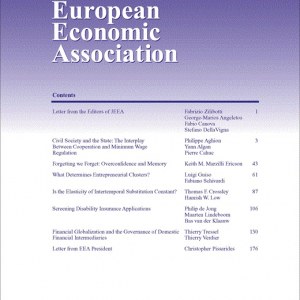
Kalemli-Ozcan, S., Sorensen, B. and Volosovych, V. (2014). Deep Financial Integration and Volatility Journal of the European Economic Association, 12(6):1558--1585.


  • Journal
    Journal of the European Economic Association

We investigate the relationship between foreign direct ownership of firms and firm- and region-level output volatility using a novel panel data set for European countries. We document a positive, highly robust, relationship between firm-level foreign ownership and volatility of value added. This relationship holds cross-sectionally and in panels with firm fixed effects where the relationship captures within firm variation over time. Considering domestic firms with assets in foreign countries, we document that it is international diversification, rather than the nationality of the owner, that explains this positive correlation. Our results can also be found at the aggregate-level, where we show that region-level volatility is correlated positively with foreign investment in the region. We show that this positive relation between aggregate volatility and foreign investment can be explained by the the granularity of the firm size distribution and the fact that foreign ownership is concentrated among the largest firms.