• Graduate Programs
    • Tinbergen Institute Research Master in Economics
      • Why Tinbergen Institute?
      • Research Master
      • Admissions
      • All Placement Records
      • PhD Vacancies
    • Facilities
    • Research Master Business Data Science
    • Education for external participants
    • Summer School
    • Tinbergen Institute Lectures
    • PhD Vacancies
  • Research
  • Browse our Courses
  • Events
    • Summer School
      • Applied Public Policy Evaluation
      • Deep Learning
      • Development Economics
      • Economics of Blockchain and Digital Currencies
      • Economics of Climate Change
      • The Economics of Crime
      • Foundations of Machine Learning with Applications in Python
      • From Preference to Choice: The Economic Theory of Decision-Making
      • Inequalities in Health and Healthcare
      • Marketing Research with Purpose
      • Markets with Frictions
      • Modern Toolbox for Spatial and Functional Data
      • Sustainable Finance
      • Tuition Fees and Payment
      • Business Data Science Summer School Program
    • Events Calendar
    • Events Archive
    • Tinbergen Institute Lectures
    • 2026 Tinbergen Institute Opening Conference
    • Annual Tinbergen Institute Conference
  • News
  • Summer School
  • Alumni
    • PhD Theses
    • Master Theses
    • Selected PhD Placements
    • Key alumni publications
    • Alumni Community
Home | News | Paper by Fellow Paul Muller in Review of Economic Studies
News | October 04, 2019

Paper by Fellow Paul Muller in Review of Economic Studies

The paper "Providing Advice to Jobseekers at Low Cost: An Experimental Study on Online Advice" co-authored by fellow Paul Muller, has been published in The Review of Economic Studies.
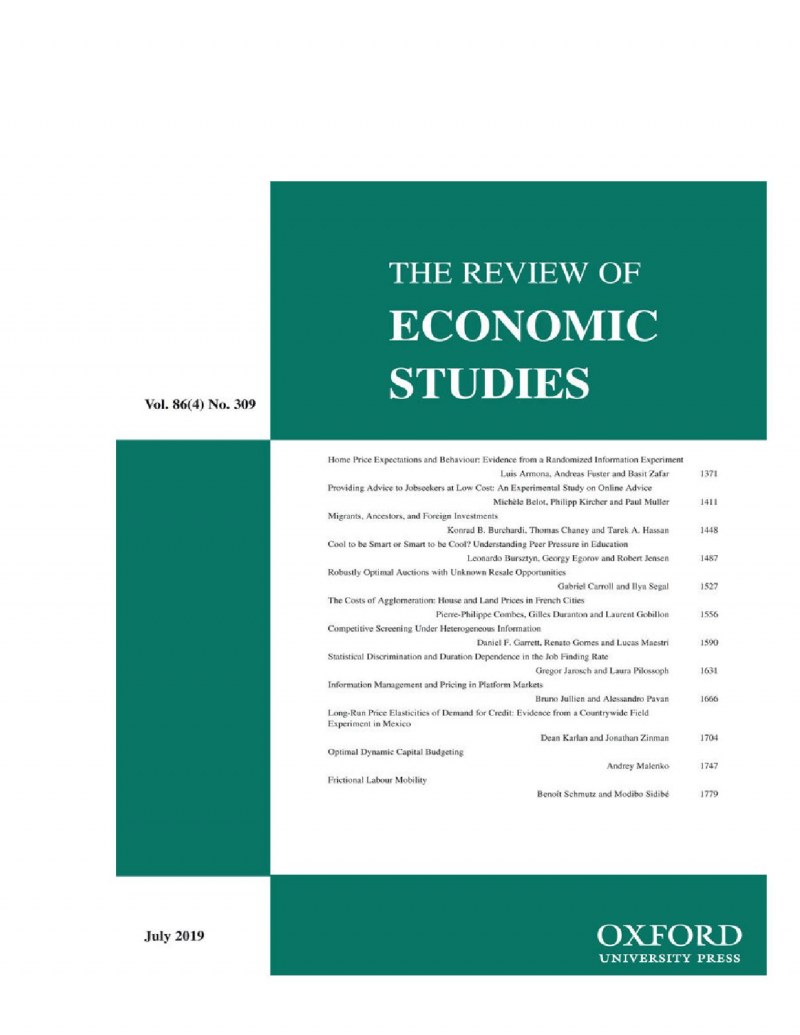
Paper by Fellow Paul Muller in Review of Economic Studies

The paper is joint work with Michèle Belot and Philipp Kircher (both European University Institute and University of Edinburgh).

Abstract

We develop and evaluate experimentally a novel tool that redesigns the job search process by providing tailored advice at low cost. We invited jobseekers to our computer facilities for twelve consecutive weekly sessions to search for real jobs on our web interface. For one-half, instead of relying on their own search criteria, we use readily available labour market data to display relevant alternative occupations and associated jobs. The data indicate that this broadens the set of jobs they consider and increases their job interviews especially for participants who otherwise search narrowly and have been unemployed for a few months.

Read full paper here.